
Helen Ward: More Than a Goalscorer - Balancing motherhood, media, and lifelong learning
Dec 08, 2025
If you asked an 8-year-old who was about to go on trial in a leaky sports hall, if they would end up with over 100 caps for their country and retire as your nation’s greatest goalscorer (at the time) with 44 goals, they would tell you to stop dreaming. If you add to that being a mother of two, head of women’s football at your childhood club and a blossoming media career, you get Helen Ward.
To make sure you don’t miss out on any of our chats make sure to subscribe to our Substack below:
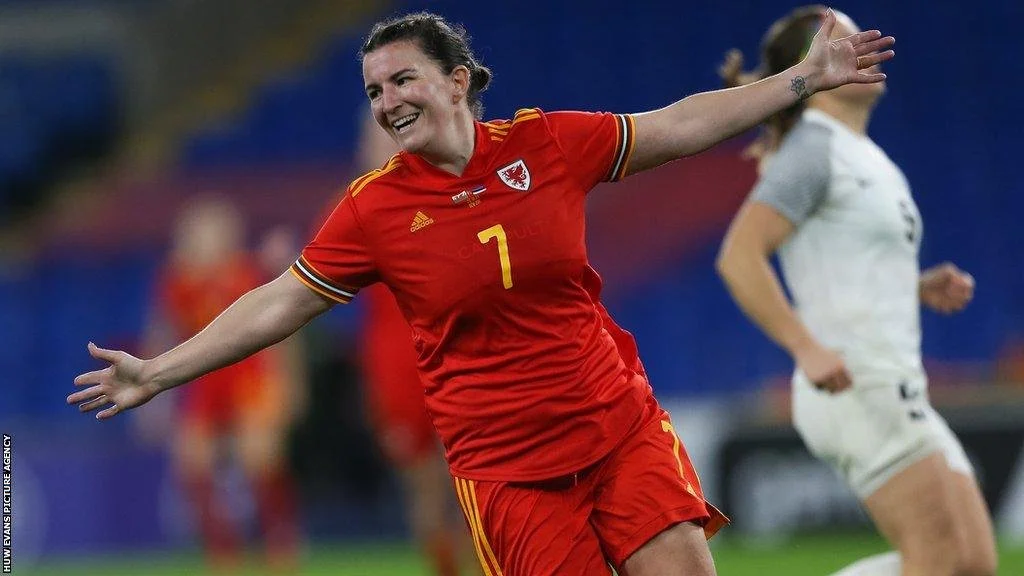
Ward celebrates one of her 44 goals for Wales. Photo credit to the BBC
Journey into football:
Helen’s introduction into football is one that will resonate with many. Being brought up in a sporty family, she would spend the weekends of her early years alongside her brother on the sidelines supporting mum and dad. She laughs that her mum reminds her that at that age she was adamant that she would never play sport due to being too boring.
As her older brother’s love for football grew, so did Helen’s exposure to the game as he would get her out into the garden and in her words to belt balls at her for hours. Clearly, she impressed her sibling during these practise sessions as one day after school he came home with a leaflet for the local girls’ team, Watford, who were looking for new players.
Endorsement from your siblings can be incredibly hard to come by at that age but with the encouragement of her brother 8-year-old Helen headed off to trials. When she arrived at a sports hall with a slippery floor due to leaks in the roof, she spent the time before the session just kicking a ball against the wall. Little did she know that this simple act to remove her boredom would set the wheels in motion for her career to come. The coach came over impressed with what he saw and told Helen that she would be training with the A team rather than the B’s (which was the normal starting point for new players). That weekend she played her first game and scored a hat-trick. This lit a fire within for both the game and goalscoring.
Balancing football and stock counts:
Helen knew that she loved playing football as a teen but at the time doing it as a full-time career wasn’t possible. So, she found work that could fit around her passion including working as a coach or as a teaching assistant which she did alongside playing up until she had her first child.
She recalls that one Christmas she got a job with a sports retail store in which she was required to do regular takes of stock on Sunday’s. Sundays were for following her passion and playing football, not for counting how many football boots they needed to order in for the following week. She never did a Sunday stock count and didn’t last long in that job. However, by staying strong to her beliefs that a job would need to fit around her football, she was able to put in place strong foundations for all that followed.
On New Year’s Day 2009, a 22-year-old Helen signed with Arsenal. This was her first contract in which she was being paid to play. She scored on her debut and stayed at Arsenal for the rest of the season before spending 3 years at Chelsea and 4 years at Reading before returning to her childhood club of Watford for 6 seasons retiring in 2023.
She chuckles as she explains how some of the younger players, she’s working with currently at Watford couldn’t get their heads around the fact that she was paying her subs at 22 just to play!
Reality of contracts and financial pressure:
It is important to note that despite the rapid growth and increase of investment into women’s football in recent years, Helen reminds us that most of the Watford squad, who are playing in tier 3 and looking to gain promotion to WSL 2 still manage dual careers. She believes that this has been beneficial for young players who have come on loan or a dual registration from the likes of Arsenal or Chelsea, as they get to hear and see that life is very different outside the top academies but the desire to get a professional contract stays the same.
Currently there are 24 clubs in the WSL and WSL2 which are fully professional with a couple in tier 3 who are almost there. This highlights the scarcity of contracts available. These contracts however are currently nowhere near what we see in the men’s game. It was recently announced that players over 23 in the WSL would receive a minimum salary of £40,000 and that it is now required for WSL 2 clubs to pay above the national living wage to enable players to be full time professionals. This certainly is progress but does not remove financial pressures especially for those in WSL 2 and below.
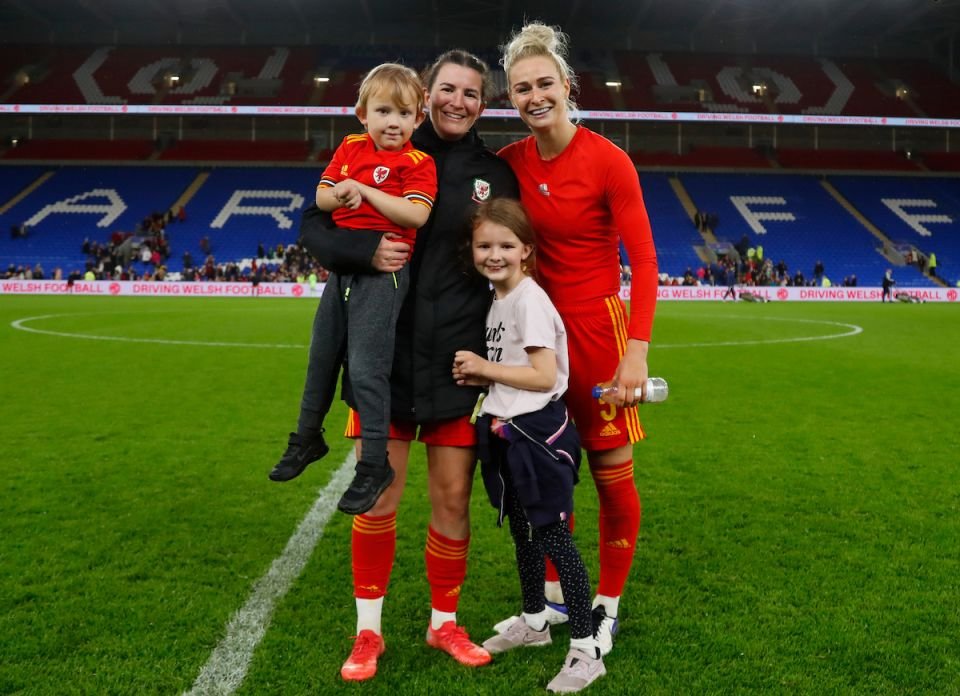
Helen and her two children photo credit to the FAW
Motherhood and a new perspective:
In 2014, Helen had her first child. During this time, she was at Reading, she was under contract but there were no maternity regulations The club wasn’t flush with cash and by mutual agreement they terminated her contract. She felt that the club could use the money to improve the squad and bring in another player while she was pregnant. Thankfully she was able to get some maternity pay from her role as a teaching assistant, but this was still a difficult time financially for Helen, her husband and their young family.
She returned to play for Reading with a new perspective. In her own words “football takes up all your brain space a lot of the time, and if you have a bad session or a bad game, it can really weigh on your mind until you next get the chance to try and put it right. But when I had Emily, that was a little bit different because I realised, I could sort of separate home from football, and I found that healthy. Whether I’d scored a hat trick or I’d been taken off after a poor game. I’d get home as an evening and my little girl would need me to love her and look after her, and she didn’t care whether I’d won or lost or whatever. So, it put things in perspective”. She believes that this perspective helped to elongate her career to keep playing till 37.
Mental health and exploring interests away from the game:
The all-consuming nature of football takes its toll mentally and Ward is a strong advocate for having a way to get away from the game and to explore areas of interest. She says “you don’t expect somebody in a normal 9 to 5 to go home and only think about work. I know it does happen, but you would never go at someone for having another interest outside their normal jobs. So why should footballers be 24/7?”.
Exploring your interests and who you are away from the game becomes super important when looking at identity. Periods of transition such as injuries, being dropped by a new coach or retirement can put increase strain on players mental health if they are unable to view themselves as anything apart from being an athlete. One thing is for sure; careers don’t last for ever. As mentioned earlier the current state of finances within the women’s game means that players will need to find a career after football.
While Helen appreciates the importance of this, it is clear to see when chatting that her passion about personal development is centred around player welfare. Shown by how she explains her worry for players retiring that, “in day-to-day football, you’re surrounded by 25 to 30 people day in day out and suddenly that’s removed. What have you got? That might be a hobby, a group of people, a new skill going to study at college or a university and getting around other people, that could be your stability, because suddenly you don’t have the stability of a football club. It’s that welfare bit where you still have to look after yourself, even if it’s not because you need the money, it’s because you’re going to need the mental stimulation and the people around you, so that it doesn’t suddenly just become very quiet and lonely”
When reflecting on her own journey, she fondly recalls when at 28 deciding to do a two-year course on sports writing and broadcasting which she found through the PFA. Other players including Alex Scott and Emma Byrne had done the course, so Helen decided to sign up. She was able to complete it alongside still playing at Reading, she explained “I had to go up to Staffordshire I think once or twice every 6 to eight weeks or something like that, I thought that’s quite manageable. I’m not working now and I’ve just got football. So yeah, I decided to go for it, and it was probably from there on that I realised I really enjoyed it, and I got one of two opportunities to do some radio and TV work”.
Helen’s first experience of doing radio was England against Wales which was tough, because Wales lost 4-0. Her introduction to TV punditry was better as she covered France V Wales in the Stade du France in which a 17-year-old Ethan Ampadu made his international debut.
Euro 2025:
This summer, Wales’s women qualified for their first major tournament. Helen had the privilege of getting to Switzerland to commentate: “The women’s Euros was amazing, and I was there the night they did it (qualified) in Dublin just about a year ago. To experience the actual games itself and the fan zones, the fan walk to the stadium, and then just the atmosphere inside the ground, the anthems, all that kind of stuff, and being able to say that that was my job for a couple of weeks’ was absolutely class and I know the results didn’t go the way that we wanted them to, but you know, you only get your first time at a tournament once, and I know that they soaked up every bit of emotion they could in terms of the players, and we’re all really proud of them.”
Wales’s group couldn’t have been harder as they faced France, Netherlands and eventual back-to-back champions England. A standout moment for Helen was, “that first anthem against the Netherlands was something else. I’ve never experienced anything like it. The girls themselves have said that they think that that impacted them. So doing it from the stands and from the press box was probably for the best”.
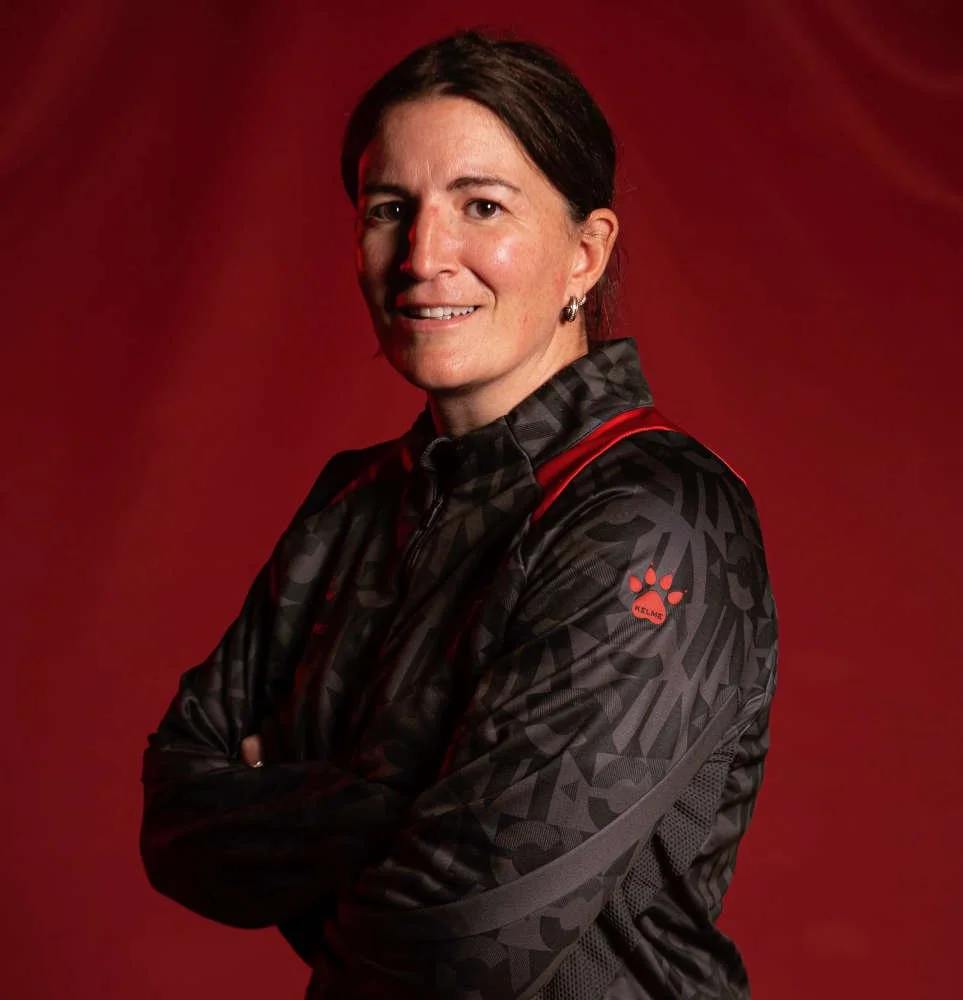
Helen’s current role is Head of Football for tier 3 Watford Women. Photo credit to Watford FC
Stepping off the pitch into the back office:
After an epic summer, Helen returned to her role as Head of Women’s football, at her childhood club, Watford. When she retired, she knew that she wanted to stay in the game in some capacity. In her words, she “just wasn’t sure what that looked like. I’d always liked the sort of pastoral side of football looking after people and, you know, I’ve tried to be a leader, I was a captain for Watford in both spells. I was working for Watford in a different capacity anyway, alongside playing. So, I’d had a few of initial conversations and then yeah, one afternoon, I had a chat with Laura Dyer, who was the interim general manager for my last season and the head coach Damon, who was there, and they said, “Look, we need a GM”. Do you fancy giving it a go?
It didn’t take Helen long to agree, after a short thinking period she thought, “Oh, I don’t know, that seems a lot. And then I thought, “But you know what? I don’t have loads of other options and why not? It means I get to stay involved. So, yeah, I applied for the job, got the job, and I’ve been sort of trying to learn on my feet ever since. There’s a lot that goes into running a team, you know, both on and off the pitch, and I massively gained respect for lots of different people in different roles that you maybe don’t get to see so much as a player.”
As a player Helen was able to have the career, she did due to a fire deep down which pushed her to keep striving for ways to improve her game. This fire and desire to finding new ways to keep getting better has come with her into her role as Head of Football:
“In this job, I’ve had to learn a lot, and I’ve always been keen to do anything to help the team. I’m in the middle of the athlete personal development and lifestyle course, which is fantastic. It’s not necessarily a qualification that my role needs, but I think it’s helpful not to just help the players themselves, but also just you know being there for people and the staff. If I can pick some things up from doing it and learn how to talk to people and how to get them to open up and discuss things and help them, then then it’s going to benefit us, right?”
Understanding people and their individual needs is at the centre of the team culture, “We really do try and look after people as people. You know, it’s person before player. You might not get picked every game and you might spend a bit of time on the bench, but that’s not because we don’t care about you as a person. That’s a football decision.”
Her commitment to continuous learning and people has helped her to create an environment for the girls to thrive and as a result the team is mounting a serious tittle challenge this year.
It was an absolute pleasure to speak with Helen and what a journey she has been on, but this is only the start!
Our key takeaways:
· The importance of perspective and how being able to not be all consumed by your sport can help performance and elongate your career
· Resilience and grit, shown throughout her story of following her passion for football at how it got her to the highest level
· Mental pressures in both playing and retiring
· How exploring your interests can open doors you didn’t know existed
· The need to invest in people and continuous learning to create winning cultures